
Teeth Bonding vs Veneers: Key Differences, Costs, Pros, and Cons
A chipped edge, a small gap, or stubborn staining can make you feel less confident about your smile. When exploring cosmetic dental treatments, two options often stand out: composite bonding and veneers.
At first glance, they may seem similar because both improve the appearance of teeth. However, the way they are carried out, their longevity, cost, and suitability can vary considerably.
Understanding the differences between teeth bonding vs veneers can help make a confident and informed decision.
In this guide, Mr Mohammed Talha Deliwala, an experienced Cambridge dental therapist with more than 13 years of clinical experience, explains how each treatment works, who it may be suitable for, and what factors should be considered before choosing either option.
What is Teeth Bonding?
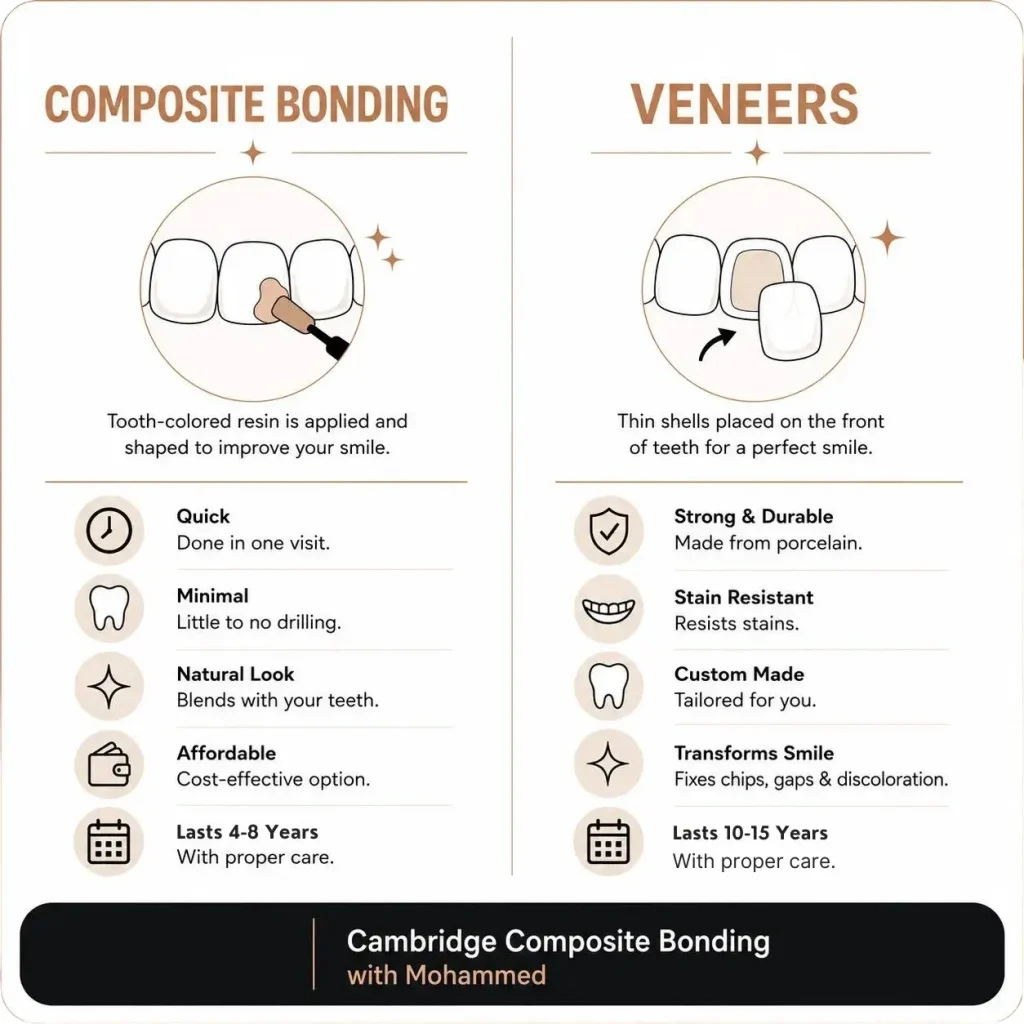
Composite bonding is a cosmetic treatment that utilises a tooth-coloured resin material for improving the appearance of natural teeth.
The material is carefully applied directly onto the tooth surface and shaped by hand to blend naturally with the surrounding teeth.
Composite bonding is commonly used to:
- Repair chipped teeth
- Improve uneven tooth edges
- Close small gaps
- Mask mild discolouration
- Improve tooth shape
- Restore minor wear
One of the biggest advantages of bonding is that it usually requires little or no removal of healthy tooth structure.
In most cases, treatment can be completed during a single appointment.
What are Dental Veneers?
Veneers are thin, custom-made shells attached to the front surface of teeth.
They are usually made from porcelain or ceramic materials. They are designed to improve the appearance of teeth that are stained, worn, uneven, or slightly misaligned.
Unlike bonding, veneers are created in a dental laboratory based on detailed impressions or digital scans of your teeth.
Because veneers are individually crafted, they offer a highly customised cosmetic result.
Teeth Bonding vs Veneers: Key differences at a glance
Feature | Composite Bonding | Veneers |
Material | Composite resin | Porcelain or ceramic |
Treatment Time | Usually one visit | Usually two or more visits |
Tooth Preparation | Minimal or none | Small amount of enamel removal |
Cost | Lower initial cost | Higher initial cost |
Lifespan | Typically 4–8 years | Often 10–15 years or longer |
Stain Resistance | Moderate | High |
Repairability | Usually easy to repair | More complex to repair |
Reversibility | Often reversible | Generally permanent |
Cost comparison: Bonding vs Veneers
Cost is often one of the first factors patients consider.
Composite bonding generally requires a less expensive initial investment since it is completed in the office rather than in a lab.
The added planning, custom creation and multiple appointments add to the overall cost of veneers.
Although bonding is less expensive up front, veneers can endure longer and might not need to be replaced as often.
The most precise understanding of treatment cost can only be provided on a case-by-case basis, the number of teeth that will be treated and the complexity of the treatment will make a difference in cost.
Which option looks natural?
Both treatments can produce attractive, natural-looking results when carefully planned.
Composite bonding allows subtle adjustments to shape and contour while preserving natural tooth structure.
Porcelain veneers offer excellent light reflection and translucency, allowing them to closely resemble natural enamel.
The final outcome depends less on the material itself and more on the planning, artistry, and attention to detail involved in treatment.
Mr Deliwala takes a conservative approach to cosmetic dentistry, focusing on results that complement facial features rather than creating an artificial appearance.
Durability and lifespan comparison
Durability is one of the most significant differences in the composite bonding vs veneers discussion.
Composite Bonding
With proper care, composite bonding may last:
- Approximately 4–8 years
- Sometimes longer with excellent maintenance
Bonding can be affected by:
- Coffee
- Tea
- Red wine
- Smoking
- Tooth grinding
Veneers
Porcelain veneers are generally more durable and may last:
- 10–15 years
- Sometimes considerably longer
They are resistant to staining and everyday wear than composite resin.
Procedure and treatment time
Composite Bonding Procedure
The process is relatively straightforward:
- Smile assessment
- Shade selection
- Surface preparation
- Resin application
- Sculpting and polishing
Most patients leave with their completed results on the same day.
Veneer Procedure
Veneers usually involve:
- Consultation and treatment planning
- Tooth preparation
- Digital scans or impressions
- Temporary restorations where needed
- Placement of final veneers
Treatment is generally completed over two or more appointments.
Maintenance and aftercare
Both treatments require good oral hygiene and regular professional care.
Helpful habits include:
- Brushing twice daily
- Flossing regularly
- Regular dental checkups
- Limiting tobacco use
- Minimising repeated exposure to food and beverages that stain teeth
- Patients who grind their teeth may also get a protective night guard.
- Proper investment maintenance can greatly increase the life of either treatment.
Pros and cons of Teeth Bonding
Advantages
- Conservative treatment approach
- Typically done in a single session
- Lower initial cost
- Minimal enamel loss
- Simple to modify or fix
- Ideal for minor cosmetic issues
Limitations
- Increased tendency to stain
- Makes up for porcelain veneers in terms of durability
- May need upkeep with time
- Not always appropriate for cosmetic changes
Pros and cons of Veneers
Advantages
- Long-lasting results
- Excellent stain resistance
- Highly customised appearance
- Suitable for more significant cosmetic concerns
- Strong and durable material
Limitations
- Higher cost
- Requires enamel removal
- Usually irreversible
- More time involved
- Repairs may be more complicated
Who is a good candidate for Teeth Bonding?
Composite bonding may be suitable for individuals who have:
- Small chips
- Minor gaps
- Slight tooth irregularities
- Mild discolouration
- Worn edges
- Good oral health
It is often an excellent choice for patients seeking conservative cosmetic improvements while preserving as much natural tooth structure as possible.
Who should consider Veneers?
Veneers may be a better option for patients with:
- Significant staining
- Multiple cosmetic concerns
- Noticeable enamel wear
- Larger gaps
- Teeth that require more extensive aesthetic correction
Patients seeking a long-term cosmetic solution often choose veneers because of their durability and appearance.
Common smile problems: Which treatment works best?
Chipped teeth
- Small chips can often be repaired successfully using composite bonding.
- Larger chips may benefit from veneers depending on their location and extent.
Gaps between teeth
- Minor gaps are commonly treated with bonding.
- Wider spaces may sometimes be better managed with veneers.
Discoloured teeth
- Mild staining often responds well to bonding.
- Deep or severe discolouration is usually better masked with veneers.
Uneven teeth
- Both treatments can improve uneven edges and irregular shapes.
- The best option depends on the degree of correction required.
Minor misalignment
- Small cosmetic alignment concerns may be improved with either treatment.
- More significant alignment issues may require orthodontic treatment before cosmetic enhancement.
Teeth Bonding vs Veneers: Which should you choose?
It is important to understand that there are two types of dental bonding available, namely, composite teeth bonding and veneers – which one is the best choice?
- There is no single solution that is appropriate for all.
- In some cases, composite bonding offers all patients what they may be looking for: conservative treatment, rapid results and excellent value.
- For others, having veneers will provide longer-lasting results and solve more advanced cosmetic problems.
These choices will depend on:
- Your smile goals
- Your teeth’s condition
- Your budget
- Your goal for life expectancy
- The amount of correction required
- The best way to find out is to have a personal consultation to find out which one is right for you.
- There is a right choice for a beautiful smile.
The most significant difference between teeth bonding vs veneers is to select the one that suits your own objectives instead of the latest trend.
When used correctly, both will yield high-quality results. For minor enhancements, composite bonding can be used, whereas veneers are a longer-lasting solution for more extensive enhancements.
Why do patients consider Mr Mohammed Talha Deliwala?
When deciding on cosmetic dental treatment, there’s more to it than just picking a procedure. It also involves selecting a dental practitioner who has knowledge of aesthetics, function and longevity of the oral cavity.
Mr Deliwala’s approach is valued by his patients because he:
- Has over 13 years of clinical experience
- Adheres to the principles of minimally invasive dentistry
- Offers detailed smile assessments
- Believes in personalised treatment planning
- Creates natural-looking cosmetic results
- Gives clear and honest advice
He has performed across India, the UAE and the United Kingdom and has a great deal of experience in each of his consultations and has a keen focus on conserving healthy tooth structure.
A beautiful smile starts with the right decision
A confident smile is not about perfection. It is about choosing a treatment that complements your features, supports your oral health, and helps you feel comfortable every time you smile.
Mr Mohammed Talha Deliwala takes a personalised approach to every patient, carefully assessing both aesthetic goals and dental health before recommending the most suitable treatment. Whether composite bonding or veneers are the better choice depends on your unique needs, expectations, and long-term goals.
If you are considering improving your smile and would like expert guidance on the most appropriate option, book a consultation with Mr Mohammed Talha Deliwala. A thorough assessment can help you understand your choices and create a treatment plan tailored specifically to you.

About the author
Mr Mohammed Talha Deliwala
BDS – Rajiv Gandhi University of Health Sciences
13+ Years Experience
3 Countries Practice Experience
GDC Registered Dental Therapist (UK)
Former Medical Director, Dubai
Expert in Cosmetic & Preventive Dentistry
Mr Mohammed Talha Deliwala is a UK-based dental therapist with over 13 years of clinical experience across India, the UAE, and the United Kingdom. He holds a Bachelor of Dental Surgery (BDS) from Rajiv Gandhi University of Health Sciences and specializes in preventive, restorative, and cosmetic dentistry, including teeth whitening, composite bonding, and periodontal therapy. Known for his patient-focused approach, he is committed to delivering comfortable, evidence-based dental care that promotes long-term oral health and confident smiles.
FAQs
Yes. Generally, the composite bonding is cheaper than porcelain veneers.
With the appropriate care, most cases are likely to last anywhere from 4 to 8 years.
In contrast to composite resin, porcelain veneers are extremely resistant to stains.
It can improve the appearance of minor misalignment, but severe orthodontic issues may require Invisalign or braces.
No, typically, very little preparation is needed to bond a natural tooth.
A thin layer of enamel is typically ground away, so veneers are typically permanent.
Yes, chipped teeth can be fixed with bonding.
When done correctly and in an aesthetically pleasing manner, both can be very natural.
Yes. For small gaps, composite bonding can often be a successful treatment.
The majority of veneer procedures will need to be done in at least two visits.
Composite bonding does not respond to whitening treatments in the same way as natural teeth. If the bonded area becomes discoloured over time, it may need polishing or replacement to match the surrounding teeth.